
Books
Explore my books, where characters and stories await to captivate your imagination.

Yugantar
The fourth century BCE is full of dangers and opportunities. Old republics are giving way to empires and cities. ‘Naastik’ sects are challenging the established varna system. The intellectual life of India is bristling like new shoots after the monsoon. The domination of the Kshatriyas and the Brahmanas is being challenged. State power is up for grabs. And the Macedonians are at the gates! Most people believe that Bharatavarsha is only a dream. But not the Yugantar, a brotherhood of the wisest and most selfless thinkers of ancient India. Interesting turn of events bring ordinary people from different parts of the subcontinent into the fold of the Yugantar -- a rebel blacksmith from Ujjayini, a Siddha doctor from Madurai; a doughty mariner from Muziris; a trader from Pataliputra and a widow nun from Kaushambi. They represent a microcosm of the sub-continent. Each of them is drawn towards the Yugantar by a strange turn of events. Each has a prowess which the Yugantar can mould into a formidable force. They converge in Takshashila, the centre of learning and transformation. This is the story of how their wit and determination contribute to a united Bharatavarsha.

Rajaraja Chola
When Rajaraja Chola ascended the throne, the land of Tamils entered upon centuries of grandeur. He left behind a stupendous legacy, which has not lost its sheen even after a thousand years. During his regime, we see powerful productive forces at work, newly liberated by the advances made in manufacturing and trade. Through interesting facts and riveting analyses, the reader can vividly experience the tumultuous developments of this perioud. It bring to life the social, political and economic underpinnings of that time - expansion of agriculture, rise of nagarams, maturing of self-governing corporate bodies, phenomenal increase in inland and overseas trade networks, and overall strengthening of the administrative and military apparatus, which would later bring South-east Asia under its influence. Equally important to the stability of the empire was the compelling iconography of Saivism, which this book presents in a sublime and engrossing style. Written by Raghavan Srinivasan, the author of Yugantar, this book recreates the history of a South Indian king and his imperial empire, in a form that would appeal to the academia and the wider public audience alike. "A rousing attempt at piecing together the lives and times of the Tamil country's most remarkable medieval personality, Rajaraja Chola, who despite the rich artistic legacy, plethora of inscriptions and maritime amnbtions, has remained an enigmatic figure." - SHARADA SRINIVASAM, Professor, School of Humanities, National Institute of Advanced Studies.
.jpeg)
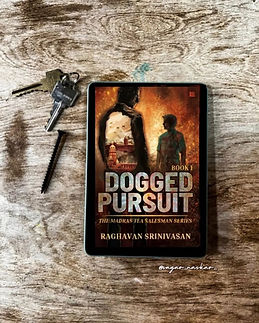
Dogged Pursuit
Raju, the main protagonist, was born a posthumous child. After losing his other parent at the age of 15 and tossed from one school to another and later from one job to another, he finally finds his home in the historic, but rapidly modernising city of Madras. Disgusted with the Endowment Department’s collusion with an artefact thief in his first job as a Temple Inspector, he shifts to a job as a Tea Salesman in a multinational company in Madras. The artefact thief happens to be Sankar, his childhood nemesis. Gaining insight from his earlier encounters with Sankar, Raju’s keen mind takes him into the dangerous realm of international antique and gold smugglers. His first mentor, Natarajan, guides him in his risky endeavours to put Sankar behind bars. It will take a lot of innovation and tenacity for Raju to make a breakthrough in the investigations. While one part of him is a daring investigator, the other part is a loving husband and father, a hard working employee and a caring friend to his other childhood friends, the communist-minded Sekar and the fickle Ganesan. The main storyline has two parallel narratives. The first is related to the growth of Madras and the other with the behind-the-scenes twists and turns in Tamilnadu.

Indian Cities Ancient and Medieval
Did You Know? The urban population during Akbar's rule had exceeded the urban population of the entire Europe of that time! By 1500 CE, the city of Hampi was the world's second-largest medieval-era city after Beijing. Dholavira, the Harappan desert city, adopted highly advanced hydraulic engineering in order to maintain the same standards of living as was seen in other Harappan cities. This Quick and Concise reference explores the beginning of urbanization in India and its advancement in science, technology, architecture, town planning, economics, art, and culture in the ancient and medieval periods. Indian Cities throws light on the political history of old cities – both lost and extant – including invasions by foreign powers or by neighbouring states. The intriguing comparisons between cities helps put information in context and makes it easy to access. Timelines and visuals further the charm of this classic reference.